Trial of Richard Hickock and Perry Smith
In Cold BloodThe trial of Richard Hickock and Perry Smith turned the investigation into a public legal contest over responsibility for the Clutter family murders. The jury found both defendants guilty of first-degree murder and imposed death sentences, but their decision did not settle which man had fired the fatal shots: neither defendant testified, leaving that question outside the courtroom record the jury considered.
Trial Structure and the Unresolved Question
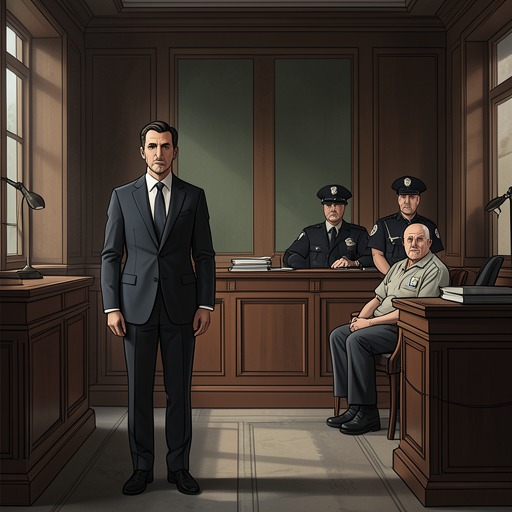
The defense case concluded on a Monday morning after only ninety minutes. The defendants declined to testify in their own behalf, so the jury did not hear either man give sworn testimony about who had actually killed the Clutter family. That omission preserved a central uncertainty even as the trial moved toward a verdict: the prosecution argued that both men were equally guilty regardless of who had pulled the trigger, while the question of the individual executioner remained unresolved at trial.
The Prosecution’s Evidence and the Conflicting Confessions
The state built its case from physical exhibits and accounts of the defendants’ statements. Four Federal Bureau of Investigation laboratory specialists testified in Washington, D.C., describing their examination of blood samples, footprints, cartridge shells, rope, and tape and affirming the exhibits’ validity. Kansas Bureau of Investigation agents then recounted their interviews with the prisoners and the confessions that followed. The defense challenged the admissions, alleging that they had been obtained through improper interrogation. The account of the trial describes that allegation as untrue and notes that the investigators denied it convincingly under questioning.
Alvin Adams Dewey supplied the most damaging testimony. His appearance gave the jury the first public account of the murders as related in Perry Smith’s confession. It also brought a conflict between the two men’s accounts into the courtroom: Smith had previously said that Dick killed Nancy Clutter and her mother, but later asked to correct his statement and take responsibility for shooting the entire family. Dewey testified that Smith had first lied to implicate Dick because he resented him, then said he wanted Dick’s mother to know that her son had not fired the shots. Smith still described Dick as responsible in another sense, saying the crime would not have happened without him.
Dewey did not accept Smith’s proposed change as a formal correction. Investigators already had a signed confession from Dick and, in Dewey’s view, ample evidence without a signed statement from Smith. The physical case also included a radio and binoculars stolen from the Clutter home and traced to a pawnshop in Mexico City. Smith’s account had led investigators to further evidence: after the killings, the men had buried spent shells and leftover cord and tape in the prairie, then burned clothing and gloves at a roadside rest area. In court, therefore, the disagreement over who fired the shots did not erase the prosecution’s broader argument that both defendants were responsible for the murders.
Defense, Closing Arguments, and Verdict
The defense presented a narrow account of Richard Eugene Hickock’s earlier life in support of a temporary-insanity claim. His father, Walter Hickock, testified that before a 1950 car accident in which his son suffered head injuries, Richard had been a happy, popular student who was considerate at home and caused no trouble. The defendants themselves declined to testify, so the jury heard no sworn account from either man about who had carried out the killings.
The state’s final arguments placed the question of punishment before the jury as well as guilt. Duane West asked for death, arguing that both defendants were equally guilty regardless of who had fired the weapon. The defense lawyers urged mercy on different grounds: Arthur Fleming appealed to Christian beliefs about the sanctity of human life, while Harrison Smith argued that capital punishment was barbaric, ineffective, and itself a wrongful taking of life. The state had retained Logan Green, a veteran criminal lawyer, to assist the less experienced West. In his closing address, Green answered the defense’s biblical appeal by citing passages that distinguish unlawful killing from the prescribed punishment for homicide, presenting execution as consistent with the same scriptural tradition the defense had invoked.
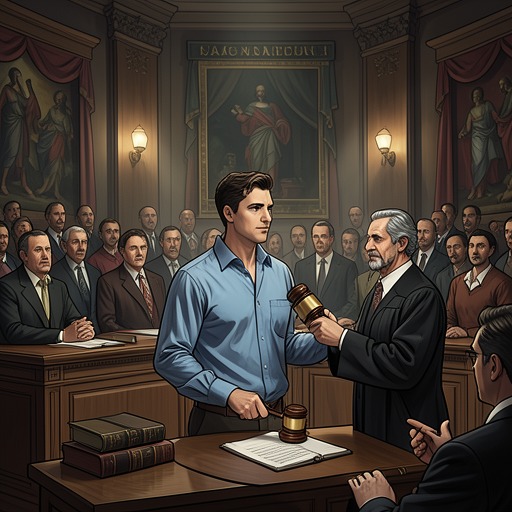
The jury deliberated for forty minutes. Judge Tate had to be brought back from his farm, where he had gone to feed his horses, before the verdicts could be read. As a Santa Fe express sounded outside, the judge found Richard Eugene Hickock guilty of first-degree murder on the first count and sentenced him to death; the remaining counts resulted in three more convictions for Hickock and four for Perry Smith, also with death as the punishment. The verdict established both men’s criminal responsibility but did not resolve who had fired the fatal shots, a question the defendants’ silence had kept outside their testimony. As they were led away, Perry Smith joked to Hickock about the jurors’ courage, and both men laughed; a newspaper photograph of the moment appeared under the caption “The Last Laugh?”
Appeals, Imprisonment, and the Sentence’s Final Consequence
The convictions did not end the case’s legal history. Richard Hickock and Perry Smith’s lawyers carried their arguments to the United States Supreme Court three times, but the Court declined to grant a full hearing on each occasion. After the men had spent almost two thousand days in Death Row cells, the Kansas Supreme Court set their executions for the early hours of April 14, 1965. Governor William Avery refused a clemency appeal, leaving the sentences in force.
The punishment was carried out at the Kansas State Penitentiary in Lansing. In the daylight hours after the executions, Alvin Adams Dewey read the news in a Topeka hotel: Richard Eugene Hickock had died at 12:41 a.m., and Perry Edward Smith at 1:19 a.m. Dewey had attended as one of the invited witnesses. The execution brought the trial’s unresolved question of who had fired the fatal shots to no new legal determination; its verdict had established both men’s guilt, while neither defendant had testified at trial.
Smith’s final remarks complicated the public meaning of the sentence. Before his execution, he said that taking a life in that manner was wrong, rejected capital punishment on moral and legal grounds, and apologized for what he had done. Dewey, who believed the punishment had been earned and regarded it as a deterrent, nevertheless felt a distinct response to Smith, whose vulnerability he could not dismiss. The trial’s outcome thus extended beyond a verdict: it became a public punishment whose final scene held together the state’s claim of retribution, Smith’s stated opposition to execution, and Dewey’s divided response.